The game always starts with the movement of a white piece. Then both participants move one piece at a time 토토사이트 on alternate turns. In professional games, white colour selection is decided by a toss while in friendly games, the less experienced player can be given the benefit of the first move.
There are some common rules of movement that are followed by all the pieces and some rules specific to each piece. The common rules are:
Only one piece can reside at one square at a time.
Pieces cannot move through each other with an exception of Knight which can jump over other pieces.
Pieces cannot take place of the same coloured piece but can take place of the opposite coloured piece by capturing (explained later) it.
Now that we know the common rules, let’s get into specific rules involved in each piece’s movement while playing chess.
The King
Chess is also called the “Game of Kings” since, for a very long time in the past, it was just played by the Nobel and Kings.
The King is the most important piece in the game but at the same time one the weakest too. It can move only one square at a time in all directions (vertically, horizontally or diagonally). But a king cannot move to a square that is under check (explained later) by the opponent.
The Queen
Queen is also very powerful mating piece. In fact, most of the checkmates in chess are through Queen.
The Queen is considered as the most powerful piece among all. She can move in all directions (one at a time) as far as she desires, provided she follows the common rules.
The Rook
Players in their first year are called “Rookies”. This name came up from the last pieces of chess to move into action called “Rooks” – How to Play Chess
Rooks can move both vertically and horizontally as far as possible, following the common rules. Both Rooks are powerful when used together, protecting each other.
The Bishop
It is possible to checkmate a lone King with 2 Bishops + King
Bishops move diagonally on the board. They always stay on the same coloured block due to its diagonal movement. Both the Bishops start from a different coloured block.
The Knight
The best position for the Knight on the chessboard is at the centre. From there, the Knight has the ability to control the maximum number of squares: 8
Knights move 2 blocks in one direction followed by one block in the other without any diagonal movement. This kind of movement makes an L shape on the board. Knights can also jump over other pieces in its movement.
The Pawn
Pawn which doesn’t have any opponent’s pawns on its way is called a past pawn.
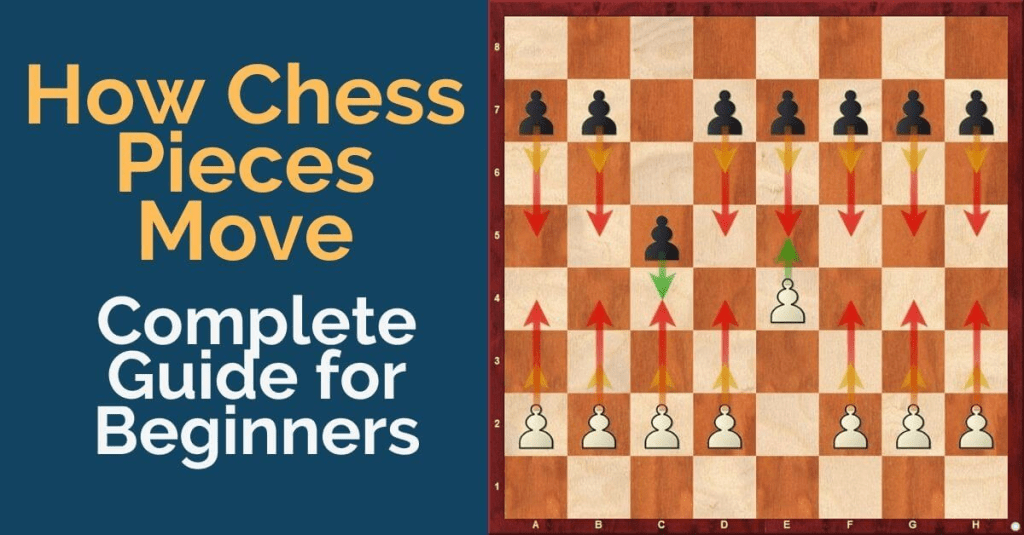
Pawns move one block forward at a time. It can also move 2 blocks but only in its first move. Pawns can change their direction only while capturing another piece which is discussed in the next section.
 Site Title